OKR alignment vs cascading: how goals should move through an org
Why copying the CEO’s OKRs down every level fails, and what to do instead.
By the OKR.ai team··6 min read
Every company that adopts OKRs hits the same question in its first quarter: once leadership has set the company OKRs, how do they reach everyone else? The instinctive answer, cascading the same goals down every level, is also the one that quietly breaks the whole system. Here’s why, and what works instead.
Key takeaways
Cascading by copying repeats the parent’s OKR at every level. It looks aligned and isn’t.
Aligning by contribution gives each team the slice of the parent it can actually move.
A child objective should never be the parent’s title with a team name appended.
Split shared outcomes by what each function controls, and write dependencies down.
Goals flow down, progress flows up: child key results should roll up into parent key results.
Cascading is the top-down practice of passing OKRs down the org chart, level by level. In its crudest form, each level copies the level above. Aligning means each team writes OKRs that contribute to a parent OKR, in language and metrics the team controls, and links them explicitly so progress can roll up.
Both start from the same place, the company OKRs. The difference is what happens at each step down.
Same company goal, two org trees. On the left the CEO’s OKR is copied down every level. On the right each team owns the part of it that it can actually change, in its own metric.
Copying looks tidy on a slide. In practice it creates four problems.
Nobody knows what they own. An SDR can’t move company ARR on their own, so a key result that says they should is either ignored or quietly reinterpreted.
Progress can’t roll up. If twelve teams all claim “Grow ARR to $10M”, the company number is counted twelve times and attributed to no one.
Teams lose agency. OKRs are supposed to let the people closest to the work decide how to reach the outcome. A copied goal removes that decision.
It’s slow. Strict cascades wait for each level to finish before the next starts. By the time OKRs reach the front line, a month of the quarter is gone.
The rule is simple: a child objective states the part of the parent its owner can move. Take a company objective, “Win the mid-market”, with the key result “Grow ARR from $4M to $10M”.
Owner
Copied (don’t)
Aligned (do)
VP Sales
Grow ARR to $10M (Sales)
New mid-market bookings from $0.8M to $4.8M
Head of Customer Success
Grow ARR to $10M (CS)
Expansion ARR +$1.8M; gross churn held under $1.0M
CPTO
Grow ARR to $10M (Product)
Ship the 6 features mid-market buyers ask for in lost-deal notes
Head of Design
Grow ARR to $10M (Design)
Week-1 activation of new teams from 38% to 60%
Each aligned OKR is in a metric the owner controls, and each connects to the parent. For the additive ones (bookings, expansion), the targets are sized so they genuinely sum to the company number. We walk through the arithmetic in key results that add up.
Pure top-down OKRs are fast to set and slow to believe in. Pure bottom-up OKRs are motivating and rarely add up to a strategy. Teams that run OKRs well mix the two:
Leadership sets the few company outcomes and the key results that define them.
Each team proposes how it will contribute, including outcomes leadership didn’t think of.
Managers review the fit: no gaps (every company key result has owners), little overlap, realistic targets.
Think of it as a negotiation in two directions. The parent sets the destination; the child decides the route and says what it needs from others.
Two directions. Managers push goals down and reports pull and adapt them; key result progress rolls back up into the parent key results.
Publish the company OKRs first, with baselines and targets. Two to four objectives is plenty.
Each function lead drafts contributions. For every company key result, ask “what part of this do we control?” and write that as your OKR.
Link each child to its parent. A key result that rolls up names its parent key result. An objective that supports another says so.
Check coverage. Every company key result should have at least one owner below it, and additive targets should sum. Gaps and double-counting show up here.
Repeat one level down, in parallel rather than waiting for every function to finish. Managers can start as soon as their own manager’s draft is stable.
Real OKRs depend on each other. Product ships what Sales sells; Operations hires and funds both. Two practices keep this honest:
Split shared outcomes by control. “Grow enterprise ARR” becomes bookings for Sales, the enterprise features it needs for Product, and retention for Customer Success. It isn’t cloned to all three.
Write dependencies down. If your objective needs another team’s work, say so in the description (“Depends on: SSO shipping by week 6”) and link it. A dependency hidden inside a key result is a surprise waiting for week ten.
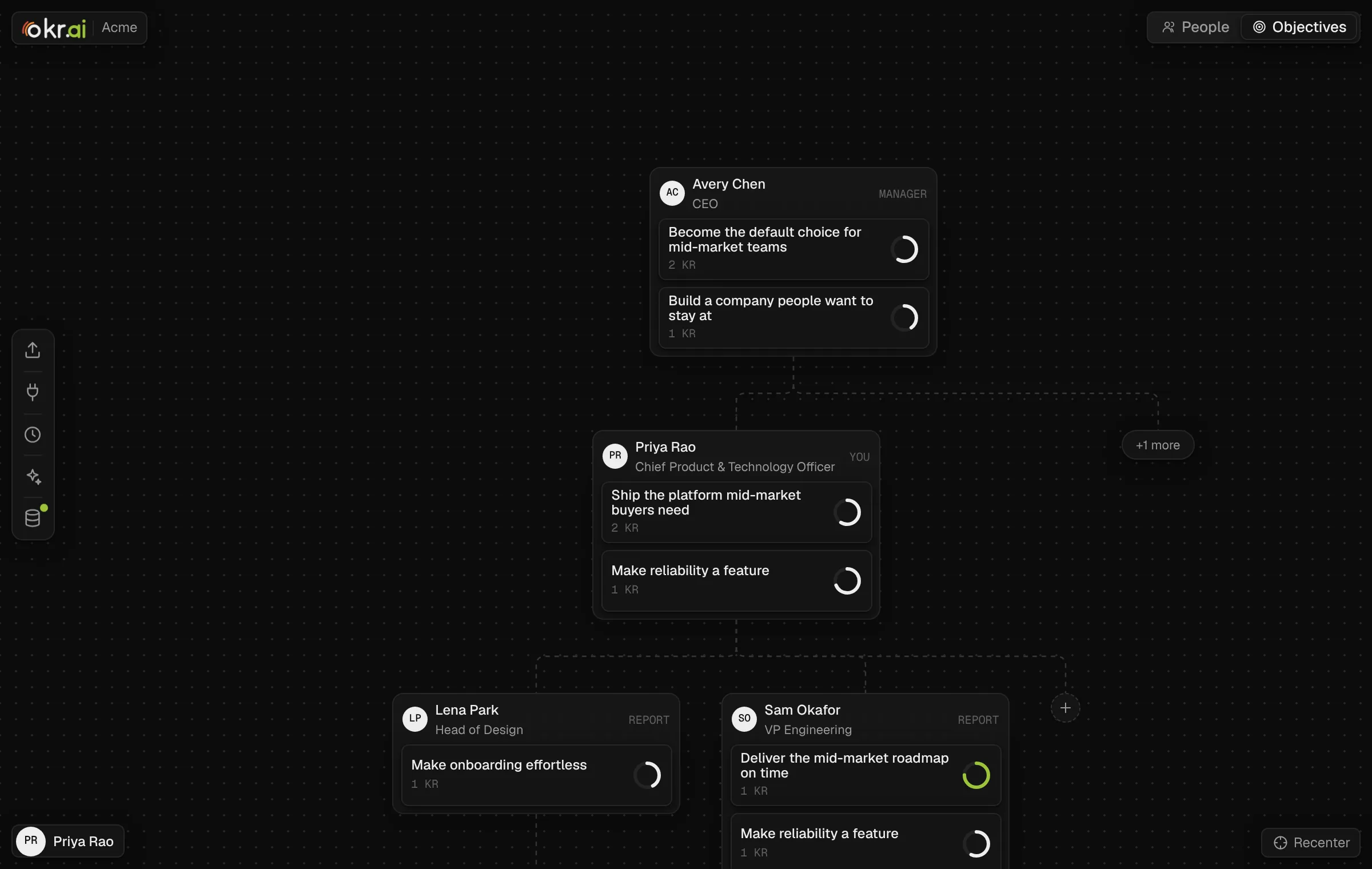
OKR.ai is built around this model. Everyone works on one canvas with their manager above and their reports below.
Pull & align with AI. From your manager’s OKRs, AI drafts yours so they support theirs, with key results sized to add up.
Push to reports. AI splits your OKRs across your reports by role and function. Each report pulls their share and adapts it.
Acknowledge and approve. Every change needs the owner to acknowledge it and their manager to approve, and anything new or changed since the last approval is flagged.
Need-to-know visibility. You see full OKRs and progress for yourself, your manager and your reports. Further away, people see objectives and key results only.
Alignment you can see. The Objectives view shows each person’s OKRs in the org tree, so a CEO objective and the team objectives that contribute to it sit on one canvas.
Goals should flow down the org, but not by copying. Each level should translate the parent into the outcome it can move, and link to it, so progress rolls back up.
Does every team OKR need to align to a company OKR?
Most should. It’s fine for a team to keep one objective for its own health, such as reducing on-call load or paying down tech debt, as long as it’s an explicit choice.
How long should alignment take each quarter?
For a company of a few hundred people, aim to finish within the first two weeks. Run levels in parallel once the level above is stable, rather than waiting for the whole tree.
What if two teams both claim the same key result?
Split it by what each controls, or give it a single owner and make the other team’s contribution an initiative or a dependency. Shared ownership usually means no ownership.