Product
Drafting OKRs from Jira, GitHub and your HR system with AI
How OKR.ai uses MCP to turn real projects and teams into a first draft worth editing.
·6 min read·Deep dive
Objectives that inspire, key results that measure outcomes instead of activity, and the five mistakes that turn OKRs into a to-do list.
Most OKRs fail before the quarter starts. Not because the team lacks ambition, but because what got written down was a task list with an inspiring title on top. This guide shows what a good OKR looks like, the rules that separate an objective from a key result, and how to rewrite the five most common mistakes.
Key takeaways
OKR stands for Objectives and Key Results. Andy Grove developed the method at Intel in the 1970s; John Doerr brought it to Google in 1999, and his book Measure What Matters made it the default goal-setting framework for tech companies.
The structure is simple. An objective says where you want to go. Two to four key results say how you will know you got there. Everything you actually do to move those numbers (projects, launches, experiments) sits underneath as initiatives.
A good objective describes a state of the world you want to be true at the end of the period. It should be short enough to remember, specific enough to rule things out, and meaningful enough that the team cares whether it happens.
A quick test: read the objective aloud to someone outside your team. If they can’t tell what would be different at the end of the quarter, rewrite it.
A key result is a measurable outcome with a metric, a baseline and a target. “Raise week-1 activation from 38% to 60%” has all three. “Improve activation” has none of them.
The rules that matter most:
Ask: “If we did this perfectly and nothing changed for customers or the business, would we call it a success?” If the answer is yes, it’s an initiative. Turn it into the outcome it is supposed to move.
Initiative disguised as a KR
Launch the new pricing page
Run 4 customer webinars
Migrate to the new CI system
Outcome key result
Lift pricing-page → trial conversion from 2.1% to 3.5%
Raise webinar-sourced pipeline from $0 to $400k
Cut median CI time from 22 min to 8 min
Here are rewrites across three functions. The “before” versions are real patterns we see constantly; the “after” versions follow every rule above.
Before
O: Improve the platform
KR: Ship v2 of the API
KR: Fix bugs
KR: Better performance
After
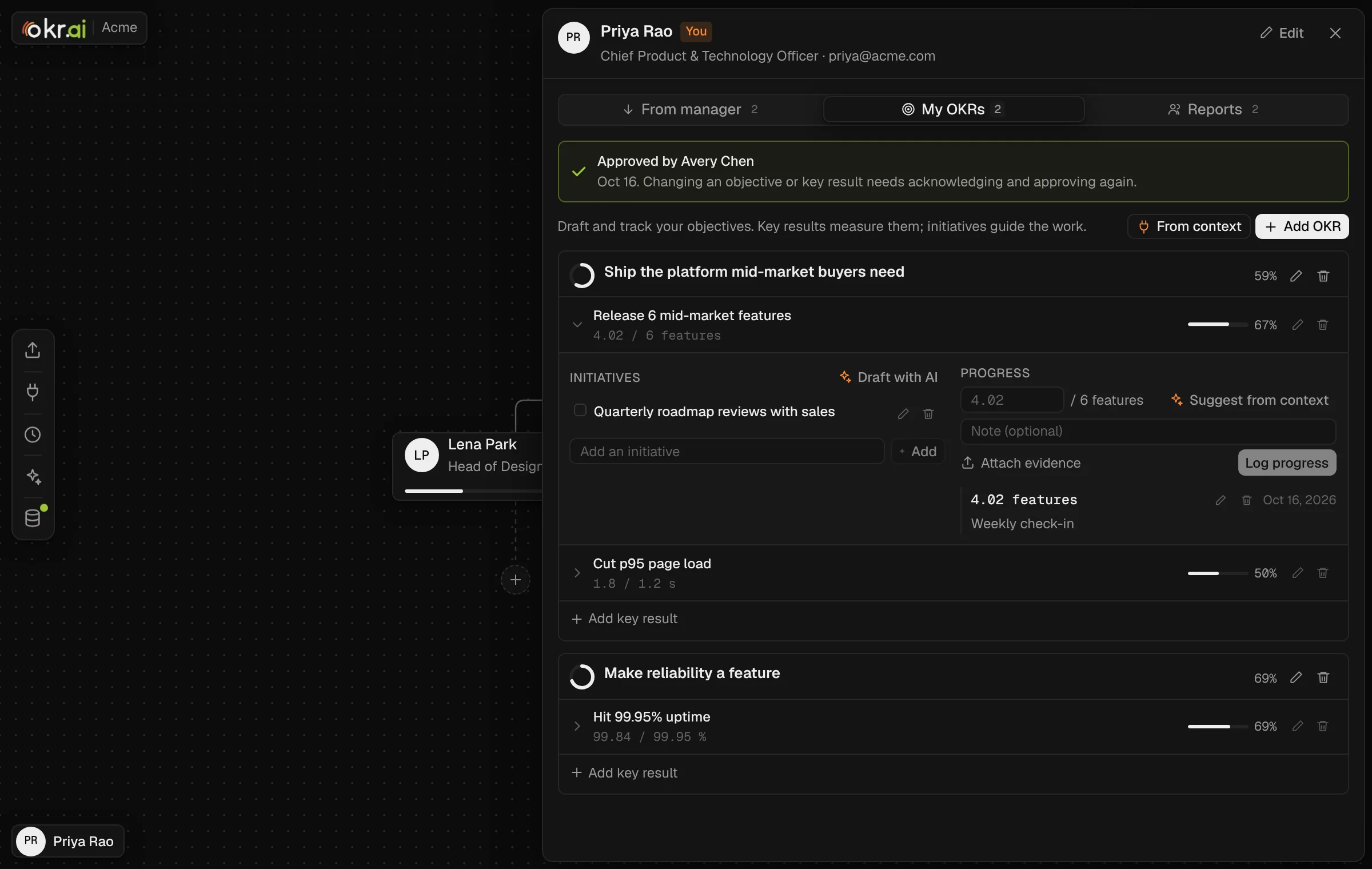
O: Make reliability a feature customers notice
KR: Uptime from 99.84% to 99.95%
KR: p95 page load from 1.8 s to 1.2 s
KR: Sev-1 incidents from 6 to ≤2 per quarter
Before
O: Grow revenue 40%
KR: Hire 3 AEs
KR: Launch a campaign
After
O: Win the mid-market
KR: Mid-market bookings from $1.2M to $1.8M
KR: Qualified pipeline from $3M to $5.5M
KR: Win rate vs main competitor from 22% to 35%
Before
O: Hiring
KR: Post jobs on more boards
KR: Do more interviews
After
O: Build a company people want to stay at
KR: Regretted attrition from 14% to under 8% annualised
KR: Time to fill engineering roles from 64 to 40 days
KR: eNPS from +12 to +30
The most common failure. Every key result starts with a verb like launch, build, run or hire. The team will feel productive, grade themselves 100%, and nothing measurable will change. Fix it with the one-question test above.
Seven objectives with five key results each is 35 things to track, which means none of them is a priority. OKRs are a tool for saying no. If everything the team does is in the OKRs, they’re a work log, not goals. One to four objectives per person is plenty; many strong teams pick one or two.
“Grow ARR to $10M (Marketing)”, “Grow ARR to $10M (Engineering)”. Copying a parent objective and appending a team name tells nobody what they own. Each child objective should state the part of the parent its owner can move. We cover this in depth in alignment vs cascading.
“Increase NPS to 50” is meaningless if you don’t know whether today’s NPS is 10 or 48. Write the baseline next to every target. If a target is a guess, say so and revisit it at the first check-in.
OKRs written in week one and opened again in week thirteen are a planning exercise, not a management system. A 15-minute weekly check-in, where each key result owner updates the number and flags risk, is what makes them work. Our week-by-week quarter playbook shows the whole cadence.
Not every OKR should be a moonshot. It helps to label each one:
| Type | What it means | Good score |
|---|---|---|
| Committed | Must happen: a contractual SLA, a launch date, a compliance deadline. | 100%. Anything less needs an explanation. |
| Aspirational | A stretch that would be a big win if reached. | Around 60–70% is healthy. Consistently hitting 100% means the bar is too low. |
Most of these rules are mechanical enough for software to check. OKR.ai’s AI coach drafts key results for any objective you write, refuses to turn activities into key results, and asks for baselines. When your manager has OKRs, it drafts yours to support theirs so the numbers add up. You edit everything before it’s saved. See how AI drafts OKRs from Jira, GitHub and your HR system, or try it on your own org in about five minutes.
One to four objectives, each with two to four key results. Fewer, sharper OKRs beat many vague ones, and a single objective for a quarter is perfectly valid.
A KPI is a health metric you monitor continuously, like uptime or gross margin. A key result is a target change in a metric over a period. A KPI becomes a key result when you decide to move it deliberately this quarter.
Generally no. Linking pay to OKR scores encourages sandbagged targets. Use OKRs to focus and align work, and assess people on impact and behaviour separately.
Only for committed OKRs where the delivery itself is the outcome, such as a contractual deadline. Otherwise measure what shipping X should change.
Update key result values weekly and review the set mid-quarter. Change the OKRs themselves only when the underlying strategy changes, not because a number is hard.